As an Amazon Associate, we earn from qualifying purchases. Some links on this site are affiliate links at no extra cost to you. Our recommendations are based on thorough research and editorial judgment.


A Beginner’s Guide to Reading Musical Notation

A beginner’s guide to reading musical notation introduces the grand staff, which combines the treble and bass clefs. The treble clef, or G clef, helps identify higher notes, while the bass clef, the F clef, focuses on lower tones. Each clef has its unique lines and spaces for notes. Practice techniques like using mnemonics, flashcards, and rhythm exercises will boost your note recognition skills. Keep exploring! There’s so much more to discover about music notation!
Key Takeaways
- Familiarize yourself with the Grand Staff, which combines the treble and bass clefs for reading higher and lower notes.
- Learn the treble clef notes by using mnemonics like “Every Good Boy Deserves Fudge” for lines and “FACE” for spaces.
- Understand the bass clef notes with “Good Boys Do Fine Always” for lines and “All Cows Eat Grass” for spaces.
- Practice identifying notes using flashcards or apps to enhance recognition across both clefs, including ledger lines.
- Improve your skills with rhythmic exercises such as clapping or tapping, which will reinforce timing and rhythm in musical notation.
The Grand Staff
The Grand Staff is like a musical bridge, connecting the higher notes of the treble clef with the deeper tones of the bass clef. It consists of two staves: the top staff uses the Treble Clef, while the bottom staff employs the Bass Clef. Each staff has five lines and four spaces, which help musicians identify note names easily. For instance, in the Treble Clef, the lines represent E, G, B, D, and F, while the spaces spell out F, A, C, and E. Conversely, the Bass Clef lines denote G, B, D, F, and A, with the spaces representing A, C, E, and G. Additional ledger lines extend this range, aiding in reading music for both higher-pitched and lower-pitched instruments! Understanding the unique features of ukuleles can enhance your overall musical experience.
Understanding the Treble Clef
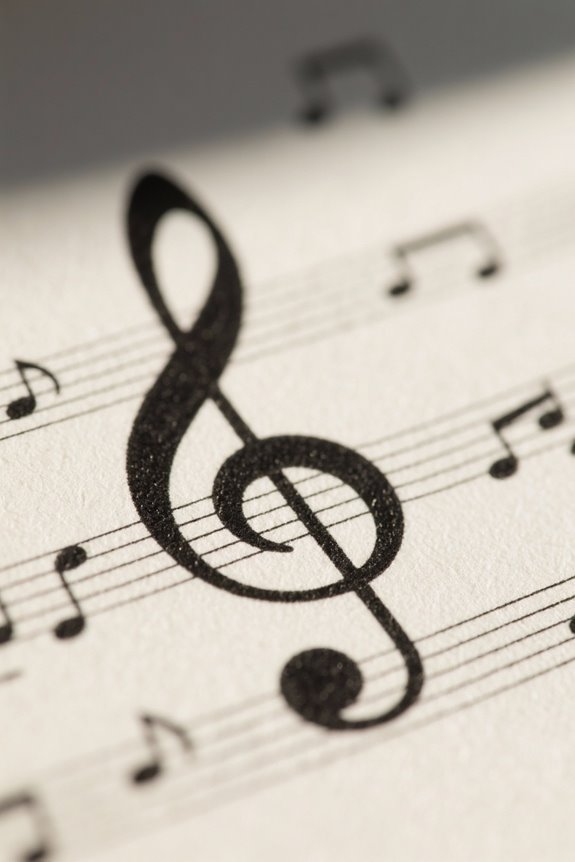
Understanding musical notation becomes much simpler with a clear grasp of the Treble Clef! This essential symbol, also called the G Clef, sits at the start of the staff. In the Treble Clef, the five lines represent notes E, G, B, D, and F, while the four spaces represent notes F, A, C, and E. To help remember these notes, many use mnemonic devices like “Every Good Boy Deserves Fudge” for the lines and “FACE” for the spaces. Typically used by higher-pitched instruments such as the flute, violin, and trumpet, understanding the Treble Clef is key to reading music effectively. By mastering these lines and spaces, you’ll reveal the joy of music notation! Additionally, using chord chart posters can enhance your learning experience and reinforce your understanding of musical concepts.
Exploring the Bass Clef
Diving into the world of the Bass Clef opens up a whole new domain of musical possibilities! Known as the F Clef, it adorns the staff where the fourth line marks the note F below middle C. In the Bass Clef, the lines represent G, B, D, F, and A, while the spaces correspond to A, C, E, and G. This clef is essential for lower-pitched instruments like the cello and bassoon, as well as the left hand in piano music. Regular practice exercises in reading Bass Clef notation can enhance note value recognition and improve overall musicianship. By mastering the Bass Clef, musicians can navigate reading sheet music with confidence and ease, leading to more proficient playing! Additionally, utilizing standardized symbols ensures effective communication among musicians, which is crucial for ensemble performances.
Notes and Ledger Lines
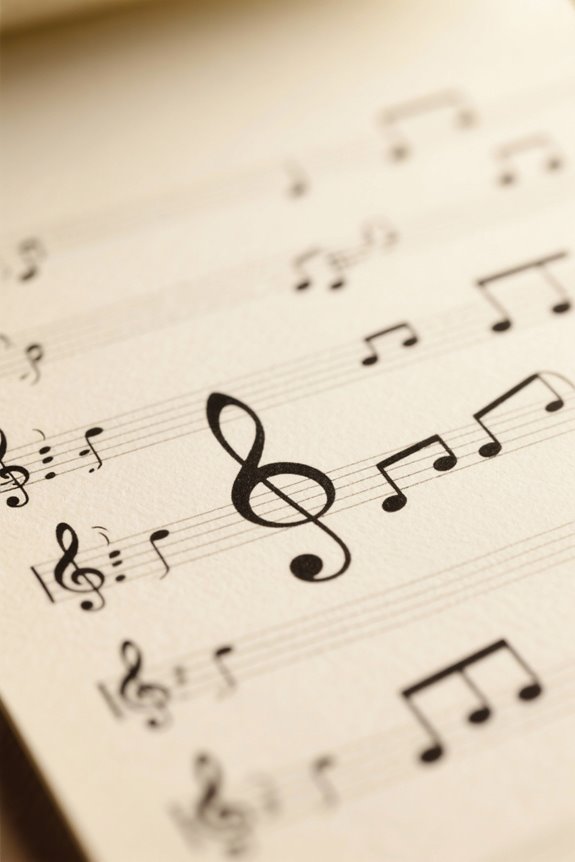
Notes and ledger lines are the fundamental building blocks of musical notation! In music, notes are represented by letter names A through G, placed on the lines and spaces of the staff. The Treble Clef and Bass Clef designate pitch ranges, with the Treble Clef highlighting notes like F, A, C, E in its spaces, while the Bass Clef features A, C, E, G. Ledger lines extend the staff, allowing musicians to play notes outside its usual range; for example, Middle C is indicated by a ledger line below the Treble Clef. Engaging in practice sessions to identify notes, including those on ledger lines, markedly enhances note recognition and boosts confidence in reading music! Additionally, utilizing visual learning aids like solfege hand sign posters can reinforce these concepts in a classroom setting. Keep practicing!
Practicing Note Reading Techniques
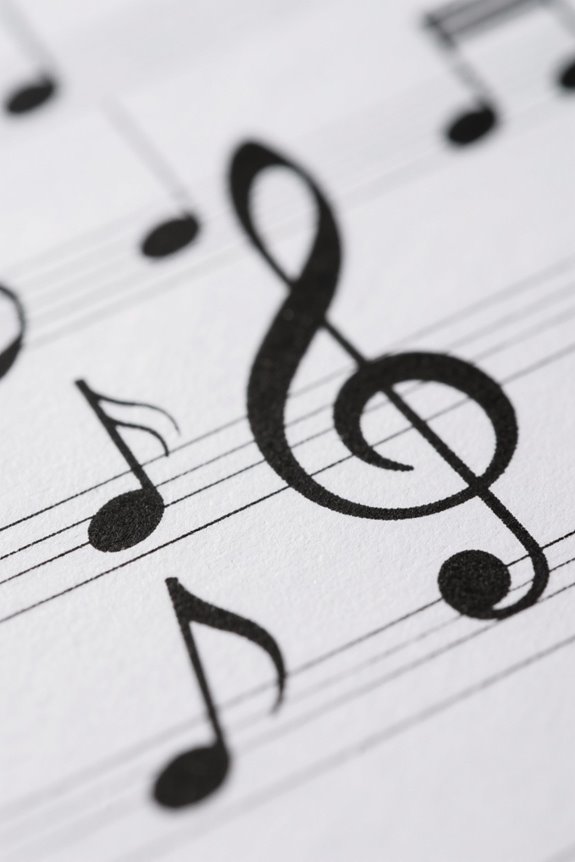
Practicing note reading techniques can transform learning into a fun adventure! By regularly practicing how to name sheet music notes on the lines and spaces of both the Treble and Bass Clefs, learners can enhance their skills. Using mnemonic devices, like “Every Good Boy Does Fine,” makes memorization a breeze! To boost note identification, using flashcards or digital apps is key, especially for challenging notes. Creating exercises by identifying notes on staff paper or in sheet music gradually builds confidence. Incorporating clapping or tapping exercises helps internalize rhythm and timing. Finally, sight-reading new pieces—paying attention to key signatures and time signatures—offers a great challenge while reinforcing music education creatively! Music note flashcards can simplify the learning process, making it easier to grasp music theory fundamentals. Jump in and enjoy the journey!
Frequently Asked Questions
How to Read Basic Music Notation?
Reading basic music notation reveals a melodious treasure chest. One must understand staff lines, clef types, time signatures, note values, dynamic markings, key signatures, and rhythm patterns, all while respecting musical rests and tempo indications.
How to Notate Music for Beginners?
To notate music for beginners, one should understand music notation basics, including staff and clefs, rhythm and meter, note values explained, dynamics and expression, ties and slurs, and common music symbols while composing for beginners.
What Are the Basics of Musical Notation?
Musical notation, a trivial endeavor, comprises notes duration, staff lines, clef symbols, and time signature. It also includes key signature, note values, rests symbols, dynamics markings, tempo indications, and articulation techniques—what a simple puzzle!
What Does 2 4 3 4 4 4 Mean in Music?
The numbers 2, 3, and 4 represent time signatures, indicating rhythmic patterns. Time signatures explained allow musicians to grasp note duration significance, beat subdivision methods, and tempo indications summary for effective performance across bass clef and treble clef.


