As an Amazon Associate, we earn from qualifying purchases. Some links on this site are affiliate links at no extra cost to you. Our recommendations are based on thorough research and editorial judgment.

Understanding Time Signatures: 4/4, 3/4, and Beyond

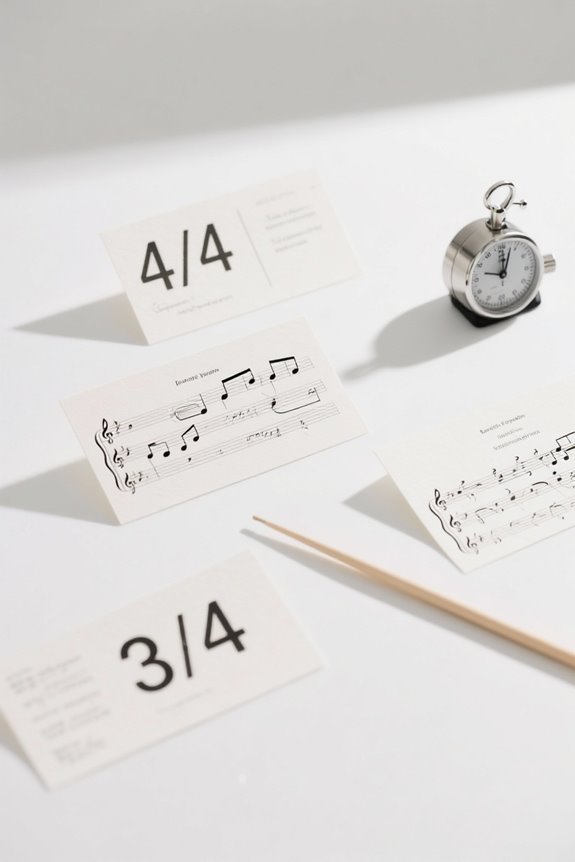
Time signatures are essential for understanding the rhythm and structure of music! The most common is 4/4, which has four beats per measure, while 3/4 features three beats, perfect for waltzes. Other time signatures, like 5/4 and 7/4, add variety and excitement to songs, such as Dave Brubeck’s “Take Five” and Pink Floyd’s “Money”. Knowing how to read these symbols helps musicians keep time and express emotions. Stick around to discover more about different time signatures!
Key Takeaways
- Time signatures indicate the number of beats per measure, crucial for maintaining rhythm and structure in music.
- 4/4 is the most common time signature, providing a balanced and familiar rhythmic feel.
- 3/4 time offers three beats per measure, often associated with waltz rhythms.
- Irregular time signatures like 5/4 and 7/4 create unique rhythmic patterns and emotional impacts in music.
- Understanding time signatures, including compound ones like 6/8, enhances musicianship and rhythmic expression across genres.
What Are Time Signatures?
Time signatures are like the backbone of music, helping to shape how a piece sounds and feels. A time signature indicates the number of beats in a measure and what kind of note gets one beat. The most common time signature is 4/4, known as common time, featuring four quarter note beats in each measure. This signature is found in many popular songs! Another example is 3/4, which has three beats per measure, perfect for that joyful waltz rhythm. Irregular meters, like 5/4 or 7/8, bring exciting twists to music, adding unique accents and rhythms. Overall, time signatures guide musicians, allowing them to keep accurate counting and rhythm while performing! Additionally, drummers often refer to drum rudiment charts to enhance their understanding of rhythm patterns associated with various time signatures.
How to Read a Time Signature
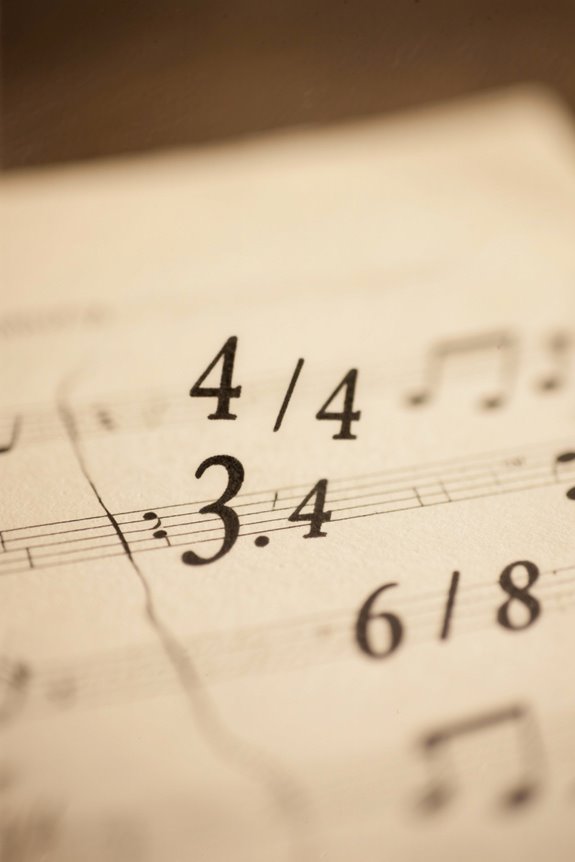
How does one go about reading a time signature, you may wonder? A time signature appears at the beginning of a musical piece, presenting two stacked numbers. The top number indicates the beats per measure, while the bottom number tells you which type of note gets the beat. For instance, in 4/4 time, there are four beats per measure, and each beat is a quarter note, perfect for lively rhythms. In contrast, 3/4 time has three beats per measure, often creating a smooth waltz feel. Understanding these elements of music notation is essential for recognizing rhythmic structure! Additionally, familiarity with essential symbols of music notation further enhances one’s ability to interpret and perform musical pieces effectively. Delving into common time signatures lays a strong foundation for appreciating music’s dynamics and flow.
Recommended Products


The information below is per-pack only

Used Book in Good Condition
Common Time Signatures

Many musicians find that understanding common time signatures opens up a world of rhythmic possibilities! The most recognized time signature is 4/4, also known as common time, featuring four beats per measure. This structure creates a balanced and steady rhythmic feel. Another popular time signature is 3/4, which offers three beats per measure and is perfect for waltzes, giving the music a flowing motion. Each of these time signatures has strong beats that help musicians keep time. Additionally, there are other significant signatures like 2/2, known as cut time, and 6/8, which emphasizes the first beat of every group of three eighth notes. Learning these time signatures is key to enhancing musical expression and performance! Understanding the concept of sound quality in relation to time signatures can also improve rhythmic accuracy.
Recommended Products

TD-07 module with 25 preset kits, 25 user kits, and 143 instruments. V-Edit, EQ, ambience, and 30 multi-effects offer deep editing tools to create your perfect drum kit sounds

Package Dimensions: 23.4 cm (L) X 13.0 cm (W) X 13.8 cm (H)

SLIM & LIGHTWEIGHT DESIGN: The Korg Liano features a full 88-key keybed in a body just 7 cm thick and weighing only 6.2 kg, making it perfect for small spaces, travel, and on-the-go performances
4/4 Time Signature

Understanding time signatures goes beyond just recognizing common ones like 4/4 and 3/4; it opens up exciting rhythmic landscapes. Time signatures are represented by two stacked numbers, indicating the number of beats per measure. For example, Common Time, or 4/4, has four beats, while 3/4 features three beats per measure, often heard in waltzes. There are also compound time signatures, like 6/8, which group beats in new ways, and irregular time signatures, such as 5/4 or 7/4, that create unique rhythms. Each time signature gives music its distinct “feel,” shaping its emotional impact. Notable songs, like “Take Five” in 5/4, show how varied rhythms can lead to innovative musical expressions! Additionally, shorter scale lengths in lap steel guitars can facilitate easier play, similar to how different time signatures influence the complexity of melodies.
2/2 Time Signature

A time signature is like a musical roadmap that guides artists and listeners alike through the rhythm of a piece. It consists of two stacked numbers: the top number shows the beats per measure, while the bottom one indicates the note value representing one beat. For instance, 4/4 is known as common time, featuring four quarter notes per measure. In contrast, 3/4, often found in waltzes, has three beats per measure. Time signatures can also reveal complex rhythmic patterns, especially with irregular signatures like 5/4. Additionally, compound time signatures—like 6/8—create a flowing feel by grouping beats into threes. Understanding time signatures enhances music’s structure, guiding performers in counting and expressing the piece’s groove! Furthermore, just like in music, the importance of signal integrity is crucial in ensuring the clarity and fidelity of sound in performances.
2/4 Time Signature
Time signatures serve as fundamental markers in music, defining the rhythm and structure of each piece. A time signature tells musicians how many beats are in each measure and what type of note gets the beat. For example, in 4/4, or Common Time, there are four beats in every measure, featuring quarter notes. Musicians often count this as “1, 2, 3, 4.” On the other hand, a time signature like 3/4 has three beats per measure, commonly found in waltzes. It’s essential to recognize these variations! Understanding different time signatures helps musicians grasp various rhythmic patterns, ultimately enhancing their performance and bringing music to life. Embracing these concepts can enrich every musical session, ensuring enjoyable moments! Additionally, mastering acoustic treatment can significantly improve sound clarity during musical performances, allowing time signatures to be more easily discerned.
3/4 Time Signature
Musical structure thrives on the use of time signatures, guiding musicians as they explore rhythm. A time signature appears at the beginning of a piece of music, like 4/4, which means there are four beats in each measure. This signature, often referred to as common time, creates a steady rhythm that many popular songs use. In contrast, 3/4 time, with three beats per measure, gives waltzes that lovely, flowing feel. Musicians benefit from understanding these signatures because they shape how music is counted. While irregular time signatures can create unique rhythms, mastering the basics of 4/4 and 3/4 helps establish a solid foundation for further exploration in music! Additionally, incorporating various playing styles into practice can enhance one’s ability to adapt to different time signatures and genres.
Irregular Time Signatures
Building on the ideas of traditional time signatures like 3/4, musicians can explore the intriguing world of irregular time signatures. These signatures, such as 5/4, 7/4, and 7/8, break away from standard patterns, creating unique rhythmic patterns. For example, 5/4 time can feel like two beats followed by three beats, as heard in the jazz classic “Take Five.” In contrast, 7/4 combines simple duple and triple meter, offering a distinct groove, famously showcased in Pink Floyd’s “Money.” Similarly, 7/8’s grouping of two, two, and three fosters unexpected accents. Understanding and using irregular time signatures can spark creativity and add exciting depth to compositions. Additionally, utilizing accurate transcriptions can help drummers master these complex rhythms and enhance their overall musical expression. So, why not plunge into this rhythmic adventure?
5/4 Time Signature
In the world of music, understanding a time signature is like having a map for guiding rhythm. A time signature consists of two numbers, indicating how many beats are in each measure and the note value of those beats. For instance, common time, or 4/4, has four quarter note beats per measure. Other different time signatures, like 3/4, often found in waltzes, feature three beats in each bar. Odd time signatures, such as 5/4 or 7/4, create unique rhythmic patterns that make songs like “Take Five” special. Conversely, compound time signatures, such as 6/8, give a smooth, flowing feel. Additionally, using a digital metronome can help musicians maintain consistent timing while navigating these time signatures, enhancing their performance and interpretation!
7/4 and 7/8 Time Signatures
Seven beats per measure may sound unusual, but the 7/8 time signature brings an enthralling complexity to music! It features seven beats per measure which can be grouped in duple and triple meters, creating a unique rhythmic feel. For instance, musicians might divide 7/8 as 2+2+3 or 3+2+2, allowing for different emphases and accents. Unlike the steady four beats per measure in 4/4, the 7/8 time signature introduces an irregular rhythm that can feel unpredictable and exciting! This makes it a favorite in progressive rock and experimental music. Understanding 7/8 demands strong counting skills, enhancing overall musical expression. Moreover, regular practice with ear training devices can significantly improve your ability to recognize complex rhythms like interval recognition. Songs like Pink Floyd’s “Money” even flirt with this fascinating rhythmic territory! Give it a try!
Compound Time Signatures
Rhythmic variety captivates musicians and listeners alike, and compound time signatures bring an exciting twist to any composition! These signatures, like 6/8, 9/8, and 12/8, each have a top number divisible by 3, creating unique rhythms. In 6/8, there are two beats per measure, each subdivided into three eighth notes, which gives a smooth, flowing feel. The 9/8 signature divides each measure into three groups of three eighth notes, often found in lively dances. With 12/8, the four beats per measure are also divided into three eighth notes, producing a delightful swaying rhythm often used in blues and gospel music. Compound time signatures enhance musical expressiveness, adding contrast to simple time signatures like 3/4.
Example Songs by Time Signature
Many musicians find that exploring various time signatures opens up a world of creativity in songwriting. The most common time signature, 4/4, is found in countless popular songs, making it a staple of modern music. For an example of 3/4, consider “Valse d’Amelie,” which captures that enchanting waltz rhythm perfectly. Jazz lovers might enjoy Dave Brubeck’s “Take Five” in 5/4 time, showcasing a unique feel. Pink Floyd’s “Money” stands out with its 7/4 time signature, adding an unconventional flair. Additionally, Leonard Cohen’s “Hallelujah” is often performed in 6/8 time, illustrating the smoothness of compound time signatures. Each of these examples reveals how diverse rhythms can inspire creativity and innovation in music!
Recommended Products


Frequently Asked Questions
How to Tell the Difference Between 3/4 and 4/4 Time?
To distinguish between 3/4 and 4/4 time, listeners can recognize waltz rhythms’ accent patterns versus march tempos, noting how dance styles and musical phrasing vary with cultural variations in song structures influencing these differences.
What Does a 4 4 Time Signature Signify?
A 4/4 time signature signifies four beats per measure, emphasizing rhythmic structure importance. It enables effective counting and variations in musical feel, commonly found in genres like pop, with historical context influencing its role in composition.
How to Tell if a Song Is in 2 4 or 4 4?
To determine whether a song is in 2/4 or 4/4, one should analyze dance rhythms, accent patterns, and rhythmic feel. Exercises involving song examples can clarify meter changes and enhance understanding of musical phrasing.
How Do You Understand Time Signatures?
Time signatures symbolize the heartbeat of music, revealing rhythmic feel and tempo significance. Mastering time signature basics through musical notation enables appreciation of genre variations and composition techniques, enriched by their historical context, ensuring coherent performance.


